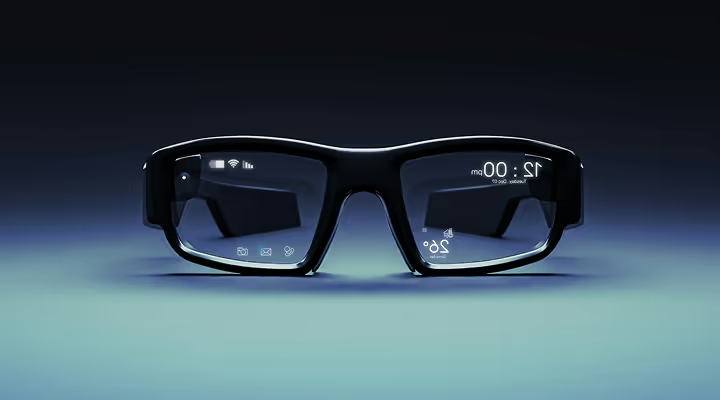

Meta recently launched its new Ray-Ban Display glasses, and for the first time, the buzz around augmented reality doesn’t feel like smoke and mirrors. It feels practical. This isn’t the “metaverse” pitch where we were all supposed to live inside cartoon avatars. This is a pair of glasses that can layer information on top of your real world — in real time.
And it changes everything.
Because what Meta, Apple, Snap, and others are building isn’t a way to escape reality. It’s access to more of it. It’s learning and working without the friction of a screen in your hand. It’s hands-free coaching, overlays in the flow of work, contextual support exactly when and where you need it.
This isn’t sci-fi anymore. It’s the early signal of something real.
From hype to utility.
The metaverse was marketed as the next frontier of human connection. But the reality was clunky avatars, expensive headsets, and no clear reason to show up. AR glasses feel different. They’re not asking you to leave reality. They’re layering intelligence onto reality.
Think about what that means for learning. No more juggling your phone for a how-to video while trying to fix a machine. No more alt-tabbing between Zoom and a reference doc. With AR glasses, the learning comes to you — literally in your line of sight — without breaking focus.
This is learning in the flow of work. For real this time.
The opportunity for learning.
The implications are huge. Imagine:
- A new hire walks the floor with instant overlays explaining equipment, safety checks, and processes.
- A frontline manager gets live prompts during a feedback conversation — subtle nudges that guide them without breaking eye contact.
- A field technician receives step-by-step instructions floating right where they’re needed, hands free to actually do the work.
That’s not a training course. That’s performance support that feels invisible. That’s coaching embedded in the job itself.
And the real breakthrough? Access.
Universal Design for Learning, amplified.
Here’s where AR glasses could be a game-changer: inclusion. Learning isn’t one-size-fits-all. Some people need translation in the moment. Others prefer visual cues layered on top of their work. Some benefit from audio prompts, while others rely on real-time captioning to stay fully engaged. Right now, those supports live across scattered apps and separate tools.
With AR, they can show up in one place — seamlessly, instantly, and without stigma. Supports don’t have to be bolted on or requested as “accommodations.” They’re just part of the design. That’s the heart of Universal Design for Learning: designing for human diversity from the start.
Risks we can’t ignore.
Of course, with big promises comes big risks.
Privacy is the obvious one. Glasses that see what you see and hear what you hear may very well collect data you didn’t intend to share. That data has the potential to empower learners — or exploit them. This is all hypothetical of course, I try to always assume good intentions.
Equity is another. Right now, devices like Apple’s Vision Pro cost thousands. Even Meta’s entry-level glasses are a luxury item. If access stays gated by price, we’ll just widen the digital divide instead of closing it.
And then there’s distraction. Just because you can layer information on everything doesn’t mean you should. Our brains have their limits, and bad AR design could create more noise than support.
I don’t believe these risks cancel the opportunity — but they do demand attention.
Why this moment matters.
For years, we’ve been promised learning in the flow of work. Most of the time, that meant someone slapped a microlearning course into a mobile app and called it a day. AR glasses flip that. They can actually deliver contextual, just-in-time support without breaking the moment.
This is why Meta’s latest launch feels different than the metaverse hype. It’s not asking us to escape. It’s helping us engage.
And if we, as learning leaders, embrace this with care — grounded in strategy, human-centered design, and UDL principles — we can reshape learning in ways that are more equitable, more immediate, and more human than anything we’ve done before.
The big picture.
AR glasses are still early. They’ll be clunky, pricey, and imperfect for a while. But don’t mistake early for insignificant. The same way the first iPhone hinted at the future of mobile everything, these glasses are the first glimpse at a future where learning isn’t something you “go take.” It’s something that’s woven into your world.
The future of learning may not live in a classroom, a course, or even a screen. It may live in the lens you put on your face each morning.
And if that future is built right — designed for real people, in all their diversity — it won’t just be more efficient. It’ll be more equitable.